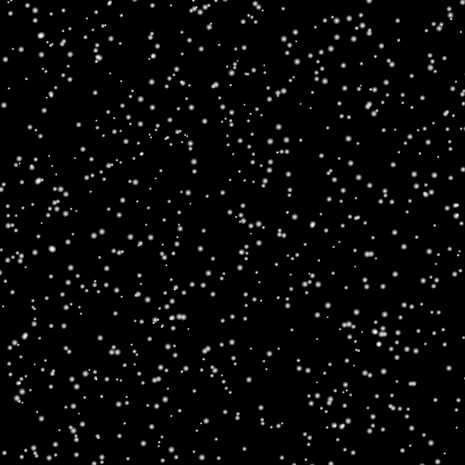
Simple Flint Test from Tutorial
Walking through the snowflake tutorial for the Flint particle system at http://flintparticles.org/tutorials/snowfall.

I've done my best to add helpful comments to the code for anyone that wants to fork this and start playing around.
♥0 |
Line 41 |
Modified 2010-11-02 01:16:25 |
MIT License
archived:2017-03-10 21:58:23
ActionScript3 source code
/**
 * Copyright dot.tominator ( http://wonderfl.net/user/dot.tominator )
 * MIT License ( http://www.opensource.org/licenses/mit-license.php )
 * Downloaded from: http://wonderfl.net/c/hOdD
 */

package {
    [SWF(backgroundColor="#000000")]

    import flash.display.Sprite;
    public class FlintTest extends Sprite {
        public function FlintTest() {

            // Testing the Flint particle library
            import flash.geom.Point;
            import org.flintparticles.common.counters.*;
            import org.flintparticles.common.displayObjects.RadialDot;
            import org.flintparticles.common.initializers.*;
            import org.flintparticles.twoD.actions.*;
            import org.flintparticles.twoD.emitters.Emitter2D;
            import org.flintparticles.twoD.initializers.*;
            import org.flintparticles.twoD.renderers.*;
            import org.flintparticles.twoD.zones.*;

            // Couldn't get the SWF metadata to work, so need to
            // draw a black box over our background. I guess.
            graphics.beginFill(0x000000);
            graphics.drawRect(0,0, stage.stageWidth, stage.stageHeight);


            // Create the renderer.
            // This one is a simple DisplayObject renderer
            var renderer:DisplayObjectRenderer = new DisplayObjectRenderer();
            addChild(renderer);

            // Create the emitter
            var emitter:Emitter2D = new Emitter2D();
            // ..and add the emitter to the renderer
            renderer.addEmitter(emitter);

            // The counter tells the emitter how, and how often,
            // to create new particles
            emitter.counter = new Steady(100);


            // INITIALIZERS...
            // Create an ImageClass instance to hold the DisplayObject
            // definition for each particle created.
            // Here, we're using the RadialDot image class which takes
            // the pixel radius as its parameter.

            var snowflakeImageInitializer:ImageClass = new ImageClass(RadialDot, 2);
            emitter.addInitializer(snowflakeImageInitializer);

            // Create a Zone to hold the starting position for each new
            // snowflake particle as it is created.
            var snowflakeZone:LineZone = new LineZone(new Point(-5, -5), new Point(500, -5));
            // Pass this zone to the position initializer for the emitter
            var snowflakePositionInitializer:Position = new Position(snowflakeZone);
            emitter.addInitializer(snowflakePositionInitializer);

            // Create a new Velocity initializer, which defines the vector for each
            // particle. The vector is (0,0) => (x,y) and describes the distance
            // each particle covers in 1 second.
            var snowflakeVector:PointZone = new PointZone (new Point(0, 50));
            var snowflakeVelocityInitializer:Velocity = new Velocity(snowflakeVector);
            emitter.addInitializer(snowflakeVelocityInitializer);

            // Create a ScaleImage initializer that randomly scales each particle
            // as it's being created.
            var snowflakeRandomScale:ScaleImageInit = new ScaleImageInit(.75, 2);
            emitter.addInitializer(snowflakeRandomScale);


            // ACTIONS...
            // Get the little suckers updating. Each "Action" is executed once per particle
            // per timer event. This basic action moves each particle according to its
            // velocity initializer.
            emitter.addAction(new Move());

            // We need to make sure these particles "die" or else we will quickly
            // bog down the Player. This DeathZone is actually the "live" zone -
            // particles that fall outside this zone will be automatically destroyed.
            var snowflakeLiveArea:RectangleZone = new RectangleZone(-10, -10, stage.stageWidth + 10, stage.stageHeight + 10);
            var snowflakeDeathZone:DeathZone = new DeathZone(snowflakeLiveArea, true);
            emitter.addAction(snowflakeDeathZone);

            // RandomDrift modifies the movement vector for each particle.
            // It doesn't seem to change on each update, so I'm not sure why this is an Action
            // and not an initializer. I have a lot to learn...
            emitter.addAction(new RandomDrift(10, 10));


            // All done.... start the emitter!
            emitter.start();
            // ...and pre-roll the animation to 10 seconds so that the particles
            // are already filling the screen when we start.
            emitter.runAhead(10);
        }
    }
}